 208 Manhattan St. Auburndale, FL 33823.
 Shopping Cart





Choosing the flowers that will rest on someone’s coffin can bring up more than you expect. You may find yourself thinking about the roses they pruned every winter, the colour of a dress they wore, or the gum leaves they always brought inside.
Around those memories sit a set of practical questions. Who chooses the flowers on the coffin? Is a full spray right, or something smaller? What is available in the middle of a Sydney winter? And what should you do when the death notice says no flowers by request?
This guide works through those decisions plainly, so there is one less thing to sort out in a difficult week.
Who Usually Orders the Flowers for the Coffin?
The arrangement that sits on the coffin is almost always chosen by the immediate family or by whoever is making the funeral arrangements. It is the central floral tribute of the service, and it usually reflects something specific about the person: a colour they wore constantly, a flower they grew, or blooms from a place they loved.
Friends, extended family, neighbours and colleagues will generally send separate floral tributes. These may include wreaths, sheafs, or posies, which are often displayed beside the coffin or elsewhere within the service rather than placed on the lid.
If you are unsure where you sit, the death notice usually settles it. Families often indicate their preference there, and following it is the kindest thing you can do.
Types of Coffin Flower Arrangements
Arrangements differ in how much of the coffin they cover and where they sit during the service.
Full Coffin Spray
A full spray runs across most of the coffin lid and forms the main floral display. It is ordered by the immediate family and is the largest arrangement at the service.
Because it covers a wide area, it can carry several flower varieties and foliage types while still reading as one considered display. For a standard adult coffin, a full spray typically spans a little over a metre. Oversized coffins need a proportionally larger arrangement, so mention the coffin size when you order.
Half Coffin Spray
A half spray covers roughly the upper or central third of the lid and leaves the rest of the coffin visible.
Families often choose this when the coffin itself has been selected with care: a figured timber grain, a hand-finished surface, or a colour they picked deliberately and do not want hidden.
Coffin Posy (Casket Posy)
A posy is a compact, rounded arrangement placed on top of the coffin. It does not extend along the lid the way a spray does.
You will sometimes see this called a casket posy, which comes from American usage. In Australia, where the tapered coffin is the standard shape, most florists will understand a coffin posy, or simply a posy for the top.
Wreath
A wreath is built on a circular frame and is usually stood beside the coffin or displayed on a nearby easel rather than laid on the lid.
Because it sits separately, it works well as a tribute from a group: a sporting club, a workplace, a street of neighbours, or a branch of the family.
Sheaf
A sheaf is gathered to lie flat, with stems bound at one end and flowers fanning out in a looser, more natural line. It is designed to be laid down, whether against the coffin, on the chapel floor or at the graveside.
Some families ask for individual sheafs so that mourners can place flowers on the coffin during the committal.
Single Stems
Not every tribute needs to be an arrangement. Many Australian services now include a basket of single roses or native stems at the chapel door, which mourners place on the coffin as they file past. It gives people something to do with their hands at a moment when that matters.
Explore Coffin Flowers Range:
Products by Category
-
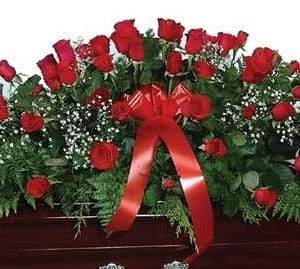
MAJ104 Coffin Arrangement
$660.00 -
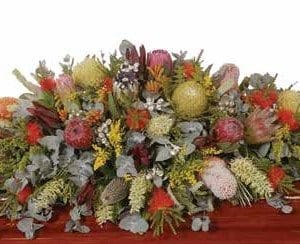
MAJ118 Coffin Arrangement
$330.00 -
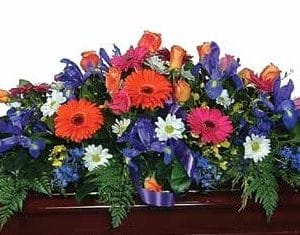
MAJ120 Coffin Arrangement
$440.00 -
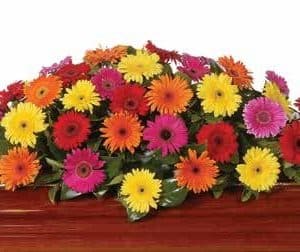
MAJ124 Coffin Arrangement
$550.00



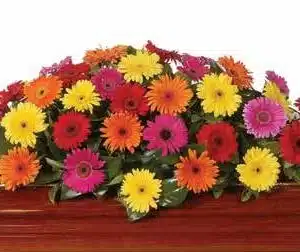
What Flowers Are in Season in Australia?
Flower availability in Australia changes throughout the year and can vary depending on the region, weather, growers and individual florist. Choosing seasonal flowers can provide more flexibility with availability and cost, but your florist can advise what is looking its best around the time of the funeral.
- December to February: Gerberas, lisianthus, orchids and hydrangeas may be available during the warmer months. Australian natives and hardy foliage can also work well in summer arrangements, particularly when durability in warmer weather is important.
- March to May: Chrysanthemums, dahlias and proteas may be among the options available during autumn. Banksias, eucalyptus foliage and other native elements can also bring warm, natural colours and texture to a funeral arrangement.
- June to August: Tulips, lilies and a range of Australian native flowers and foliage may be available through winter. Banksias, flowering gum and eucalyptus foliage can be considered for families who prefer a more natural Australian-style tribute.
- September to November: Spring can bring a wider choice of seasonal flowers, including waratahs, boronia, kangaroo paw and peonies. Some varieties, particularly waratahs, have relatively short natural flowering periods, so availability is best confirmed with your florist.
If a flower that holds special meaning is unavailable, your florist may be able to suggest another variety with a similar colour and Shape. This can help preserve the personal meaning of the arrangement without relying on one particular flower.
What Different Funeral Flowers Mean

Meaning attaches to flowers through tradition, through culture and through personal memory. None of it is binding.
- Lilies: Long associated with peace and remembrance. Orientals such as Casablanca carry a strong scent, which can be overwhelming in a small chapel, so Asiatic lilies are often the gentler choice indoors.
- Roses: Red for deep love, white for remembrance, pink for gratitude and affection, yellow for friendship. Roses tend to feel right for a partner, a parent or a sibling because the association is so direct.
- Chrysanthemums: In Australia the chrysanthemum is the Mother’s Day flower, which gives it a warm domestic association for many families. In Chinese, Vietnamese and Korean traditions, white chrysanthemums are closely tied to mourning and are often the expected flower at a funeral. In parts of Europe they are used almost exclusively for the dead. Worth a conversation with the family if you are sending rather than choosing.
- Australian natives: Banksias, waratahs, grevilleas, flowering gum and eucalyptus foliage bring texture and bush colour that imported blooms cannot. For someone who camped, gardened, bushwalked or simply loved the smell of eucalyptus after rain, natives often say more than roses would. They also hold up better in heat than most cut flowers.
- Carnations: Often overlooked, but they last longer than almost anything else and are the traditional choice in many Catholic and Southern European Australian families.
Traditional meanings can be helpful, but personal connections may matter more. A flower your loved one grew, carried or simply enjoyed can make the arrangement feel more personal and connected to their memory.
Cultural and Religious Considerations
Sydney services span many traditions, and floral customs differ considerably.
In Jewish funerals, flowers are generally not part of the service, and a donation to a charity or a visit during shiva is the appropriate gesture. Islamic funerals vary by family and community, with many keeping floral tributes minimal or absent. Chinese and Vietnamese services often centre on white and yellow chrysanthemums, and red is avoided. Hindu services frequently use garlands, particularly marigold and jasmine.
If you are unsure, ask the funeral director. They will know what the family has arranged and will save you an awkward guess.
Matching Flowers to the Coffin
The coffin’s finish can guide the palette without dictating it.
White, cream and green foliage lift darker walnut and rosewood finishes. Deeper reds, burgundies and purples add warmth to a pale or blond timber. Natural and raw timber finishes sit well with muted tones, dried elements and native foliage. A solid white coffin can take almost any colour, including bright ones.
The arrangement should also sit in proportion. A spray that overwhelms the lid hides details the family chose deliberately. A gentle contrast lets both the flowers and the coffin be seen.
You can view the Majestic Funerals coffin and casket range with this in mind.
When the Notice Says No Flowers by Request
Australian death notices may include phrases such as “no flowers by request,” “family flowers only,” or “donations in lieu of flowers.”
When a family makes this request, respecting their wishes is an important part of showing care. They may prefer donations to a charity that was meaningful to their loved one, wish to keep the service simple, or choose to have flowers arranged only by close family.
If a charity is named, you may choose to make a donation in the person’s memory. If no alternative is suggested, a heartfelt card, a message of support or simply being present at the service can still offer comfort and let the family know they are in your thoughts.
What Do Coffin Flowers Cost in Sydney?
The cost of coffin flowers in Sydney can vary depending on the arrangement, flower choice, seasonal availability and florist. Some families may prefer a simple posy or sheaf, while others choose a larger coffin spray as the main floral tribute.
The prices below are a general guide only, as actual costs can vary depending on the flowers available and the arrangement chosen.
| Arrangement | Indicative price |
|---|---|
| Single stems | $8–$20 per stem |
| Coffin posy | $120–$250 |
| Sheaf | $130–$300 |
| Wreath | $180–$450 |
| Half coffin spray | $250–$450 |
| Floral cross | $250–$600 |
| Standing spray | $250–$550 |
| Full coffin spray | $400–$900+ |
| Ribbon sash with lettering | $25–$60 |
Larger arrangements and imported or out-of-season flowers may increase the cost. If you have a particular budget, let your florist know. Choosing seasonal flowers or colours that hold a special connection to your loved one can help create a meaningful tribute while allowing flexibility around the flowers used.
Frequently Asked Questions
1. Who pays for the flowers on the coffin?
The flowers placed on the coffin are usually arranged and paid for by the immediate family or the person organising the funeral. They may order the flowers directly from a florist or arrange them through the funeral director as part of the service.
2. What is the difference between a coffin spray and a wreath?
A coffin spray is designed to rest directly on the coffin and usually forms the main floral tribute. A wreath is a circular arrangement that is generally displayed beside the coffin or on an easel and may be sent by family, friends or other groups.
3. Can flowers go into the grave or the cremator?
This depends on the cemetery or crematorium and the materials used in the arrangement. Individual flowers may be permitted, while items such as wrapping, wire or floral foam may need to be removed. Check with your funeral director beforehand.
4. How long will the flowers last?
How long coffin flowers remain fresh depends on the flower variety, weather and how they are cared for. Hardy flowers and native foliage may last longer, while delicate blooms can fade more quickly, particularly during warm Australian weather.
5. Can I send flowers after the funeral?
Yes. Sending flowers after the funeral can be a thoughtful way to show someone that they remain in your thoughts. A small arrangement or personal note in the days or weeks afterwards can offer comfort during the quieter period that follows the service.
Choosing Flowers That Feel Personal
There is no single flower or arrangement that can express everything someone meant to you.
For some families, white lilies and greenery may bring a sense of peace and familiarity. For others, it might be bright roses, Australian native flowers, or colours that bring back memories of a garden, a special place or a moment shared together.
What matters most is that the flowers feel connected to the person you are remembering. Sometimes, the simplest choices can carry the deepest meaning and become a quiet reflection of the life, love and memories you shared.
When you are ready, Majestic Funerals can help you bring these personal touches together and create a farewell that feels true to your loved one.